
My thesis: CAUSATION AND THE UNIVERSE
A bridge between the nineteen hundreds and the two thousands (X2)
E=m*cos (θ)*qc2
Text: Roger M. Klang
Physicists’ models assumes that the highest possible temperature is the Planck temperature, with the value 1.416785(71)×1032 kelvin.
E=m*cos (θ)*qc2
Or;
td=m*cos (θ)*qc2
45 degree angle; 10000 degrees kelvin; mass equal to 1;
1*0.7*10000*299,7922 =6.3*1014
60 degree angle; 10000 degrees kelvin; mass equal to 1;
1*0.5*10000*299,7922 =4.5*1014
80 degree angle; 10000 degrees kelvin; mass equal to 1;
1*0.17*10000*299,7922 =1.53*1014
________________________________________________
45 degree angle at Planck temperature and the mass equal to 1.5
1.5*0.7*1.416*1032*299,7922 =1.33627*1043
The equation for energy involving both mass, its velocity and thermal energy after E equals, I contend, is E=m*cos (θ)*qc2 The q is the thermal entropy in one direction caused by the directed jet propulsion angle. The given angle cannot be 0 or 180 degrees, or E wouldn’t increase. This equation can show one possible limit for the amount of energy, iff the universe we know has a certain shape and angle from the origin of space, and if we can know the initial mass. You could also put td for time dilation instead of E on the left side of the equation sign so that it reads
td=m*cos (θ)*qc2
They are synonymous. The equation doesn’t explain the cause of the universe, but it does imply the shape of our known universe. What if the universe originated from something like a speeding bullet exploding into a quarter circle (or smaller piece of a circle, or a drop formation) forwardly expanding direction. It would make the universe significantly older than scientists think, particularly if it has got a drop formation. But the estimated mass of 1.5*1053 kg for the whole observable baryonic universe is far, far greater than what we get out of the equation td=q*cos (θ)*c2 where q is Planck temperature. Not quite there since 1.33627*1043 is not nearly as much. But, mass is not a constant, I assert in my book. Still, there is a vast gap between 1043 and 1053. So, maybe this added formula E=m*cos (θ)*qc2 cannot be applied to the origin of the universe. But it is applicable to jet airplanes, I know that. Thus it is a valid equation. Still, it does not align with the equivalence principle. Why is that? Well, I know why, I am just asking a rhetorical question. But why then can the formula be applicable to Jet airplanes? With my calculus, a small airliner, with a 20 degree jetbeam in the air, display an energy level equal to:
E=m*cos (θ)*qc2
6.77*1018=40,000*0.9397*2000*300,0002
In the splitting of an atom at an atom bomb explosion, a single split atom developes an energy level equal to (remove cos (θ) from the equation):
E=mqc2
1.494*10-8=1.66*10-27*100,000,000*300,0002
*The speed of light above is approximated.*
In both instances it is a large number for the respective reference frames. But the value is not in Joules since one joules equals 1 kg*m²/s². Where m2 is meter squared and s2 is seconds squared.
Numbers keep climbing if you for instance instead of a small airliner with a mere 40,000kg take-off weight do the calculation on an Airbus A380 weighing in at 575,000kg at take-off. You then end up with an energy level of 9.73*1019. That is why it is a usable formula in the first place.
But the formula E=m*cos (θ)*qc2 is merely a product of multipliers. Thus, all you do is multiplying different energy forms, and you can do this with other converting unit factors too. That is exactly my point. I profess that mass and thermal energy simply are two forms of energy, sometimes displayed in opposite directions in our universe, and that the phenomenon time dilation equals total energy which depends much on the factor of thermal energy q. Like this;
td=m*cos (θ)*qc2
If we can use the formula as an indicator for the origin of our universe is really just a bonus. But it would be neat if we could. Albeit, if the formula is correct, it would mean that the equivalence principle is wrong, as mentioned. Setting up a fundamental and consistent formula for time dilation based on mass and thermal energy would be difficult. But it fits my model well.
The first part of my book (up to and including page 94), is my problem shooting concerning some of the physics problems that we up to now haven’t been able to solve satisfiedly. There are many explaining graphs in this book. This is not a TOE or a GUT. What is? My theory is to a high extent a theory of causality. B follows on A. Therefore, although my book does not deal with the abstract subject, I lean towards Roger Penrose’s Penrose diagram because of its causality, rather than the “many worlds” hypothesis.
A book is never finished. But it is good enough to publish, after nearly 16 years of authoring. If it had been possible, then I would have written this thesis in the form of an academic paper, but the theory/theories are too comprehensive to fit in the format the academic institutions limit it to.
________________________________________________________________________________________
Isaac Newton’s first law states that if a body is at rest or moving at a constant speed in a straight line, it will remain at rest or keep moving in a straight line at constant speed unless it is acted upon by a force.
A refutation of Isaac Newton’s first law:
- If a body is in orbital motion with a given sufficient apogee and perigee it will stay in orbit in an energy-conserving state if there aren’t any adequate amounts of accurately directed energy to it.
- Thermal energy [or electro-magnetism] is required direct to make matter move in straight or otherwise non-orbital trajectories.
Isaac Newton lived in a time when the Universe was considered static and constant by scientists. There was no beginning and no end, and the Universe certainly didn’t expand. Because of the false belief of the time that the Universe was static and constant he couldn’t, without revoking that common notion of the times, have concluded what I have concluded that actually the orbital motion is the energy-conserving motion which need a force to act upon a body for it to not keep orbiting around a larger object, and that it is the body which need an extra force of energy to leave a gravitational field. Newton didn’t consider a starting block for everything, like the Big bang. And what is the Big bang? It is added energy creating matter moving in straight trajectories. What is orbital movement? It is an energy-conserving motion for a body.
Albert Einstein came up with the theory of Relativity, his most important thesis, at the time when the Universe was still being considered static and constant. Einstein was unable to realize that a body must have an absolute speed limit below the speed of light, and because of this the Special theory of Relativity results in an all-out theoretic assumption about time dilation. Time dilation is real, yes, but Albert’s relativistic theory is a hypothesis somersault since his theory presupposes no speed limit for a body. Bodies in motion are considered to have relativistic speed by Einstein even though he didn’t believe in an absolute speed scale, or precisely because he didn’t believe in an absolute speed scale. And why wouldn’t he have considered bodies to have relativistic speed when the Universe was considered static and constant by him and his academic peers? Einstein’s theory is the blueprint of God’s construction, but Einstein didn’t consider the physical limitations of the building blocks for the structure of the universe.
The Author
________________________________________________________________________________________
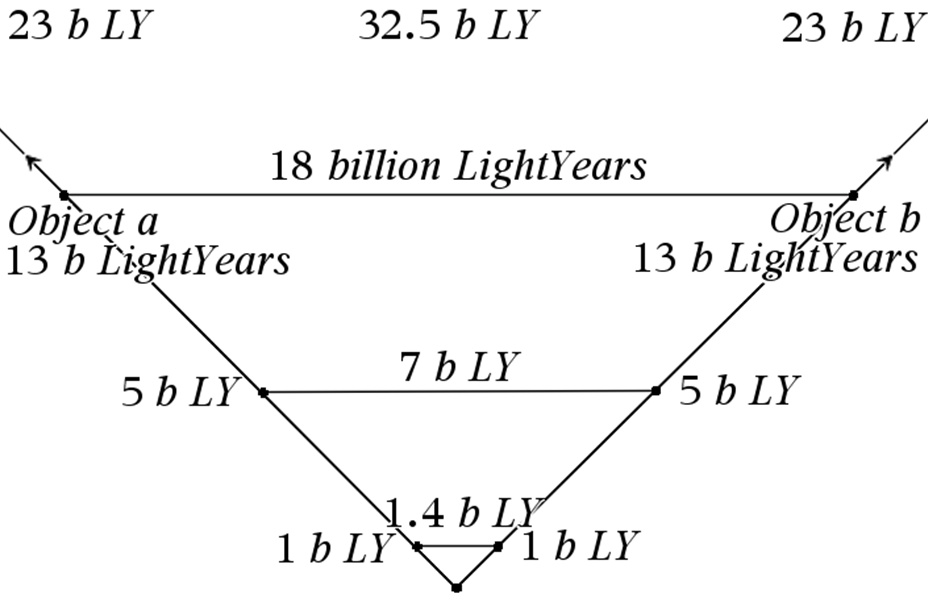
Let us slap the Pythagorean theorem onto the universe. In the image above, Objects a and b separate from each other in a ninety degrees angle at a speed well below the speed of light. The distance to the allegedly ascertained beginning of the universe is 13 billion lightyears for both Object a and Object b. The distance between Object a and Object b is then 18 billion lightyears. For the GN-z11 to be 32 billion lightyears apart from our galaxy, our galaxy must be 23 billion lightyears old. That is if we had been located at the edge of the universe as well as the GN-z11 had been located at the other edge. Obviously, we are not located at the edge of the visible universe. Since most of the objects in the universe have a velocity well below the speed of light, we should expect the universe to be much, much older than 13 (or perhaps 23) billion lightyears of age. Thirty-two billion lightyears is how far we to date can see, given that we are correct in our assessment of the distance from our galaxy to the GN-z11. Object a and object b in the image above have always been within “sight” of one another since the early universe. The luminosity from the origin of the universe has long since surpassed us since light travels at 300,000 km per second. Say that most of the galaxies in the known universe have a velocity of about 67 km per second. So, if the assessment for the expansion speed is correct, then the age of the universe must be more than 300,000km/s/67km/s~4478 times larger. Because it would take 4478 times longer for Object B in the image above to reach a distance from Earth where we can detect Object B at a 32 billion lightyear distance (based on Object B’s redshift). Most of the emitted light from Object B, that we can see, have long since surpassed us here on Earth. Only light leaving Object B at approximately 32 billion lightyears ago is visible to us.
23 billion lightyears x 4478~100 trillion years old, but supposedly more like double. Unless there was inflation. Lightyear is a yardstick but also an age.
If the scale of the universe is 100 trillion years of age or rather twice that, this would explain why the universe’s galaxies are not noticeably more densely packed the further back in time we look from Hubble and James Webb. With the aid of telescopes, we can see only a fraction of the universe. It would also explain why mega-structure formation of galaxies like “the Big ring” and “the Giant arc” can have developed in our universe. They had time!
I have imaginary set up the calculation according to the Pythagorean theorem for a right-angled triangle i.e., a2+b2=c2 and then calculated the square root of c2 to get a horizontal distance between Object a and Object b in the image above.
________________________________________________________________________________________
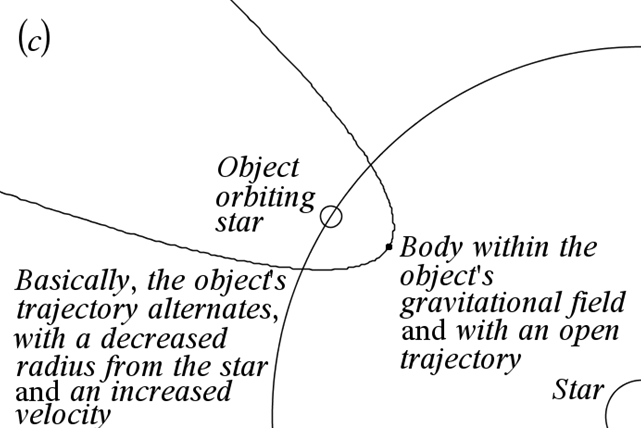
(a) A small body passing through a gravitational field changes course and accelerates. [Or it becomes caught in an orbit around the larger object.]
(b) The larger object’s velocity is decreasing. And the larger object’s orbit around the central star alternates a certain bit too, albeit this is very marginal and corresponds with the amount of energy the small body ”steals” as it pass through the large object’s gravitational field once. The large object’s trajectory alternates, basically with an increased radius from the star.
(c) One special circumstance is if the small body crosses paths (circumvents) with the larger object which is in orbit around a star or something. Then it will be the small body coming from outer space that loses energy in favor of the larger object, and the small body changes course with a decrease in speed for the small body which will appear to fall towards the larger object, if the body is within the larger object’s gravitational field. The large object’s trajectory alternates, basically with a decreased radius from the star, when the body is circumventing.
________________________________________________________________________________________
Teaser for my total rebuttal of Kurt Gödel’s Incompleteness theorem, also in the book.
So we have two statements:
- A means that A is unprovable
- False formulas are unprovable
One can easily replace (1) with either “False A is unprovable” or “True A is unprovable”.
(- +) = (-) (imaginary)
(+ +) = (+) (true)
(- -) = (+) (true)
(+ -) = (-) (imaginary)
The following is an explanation of what I am claiming here:
- We would get (- +) = (-) (imaginary) if A could be false and provable, which it cannot. False propositions cannot be proved true.
- We get the formula (+ +) = (+) (true) if it is true and provable.
- We get (- -) = (+) (true) if it is false and unprovable.
- Thus we get the formula (+ -) = (-) (imaginary) for the true and unprovable.
________________________________________________________________________________________
 Det Tyska Kriget